10 Emerging Artists from Zimbabwe You Should Keep an Eye On
by Katica Kocsis
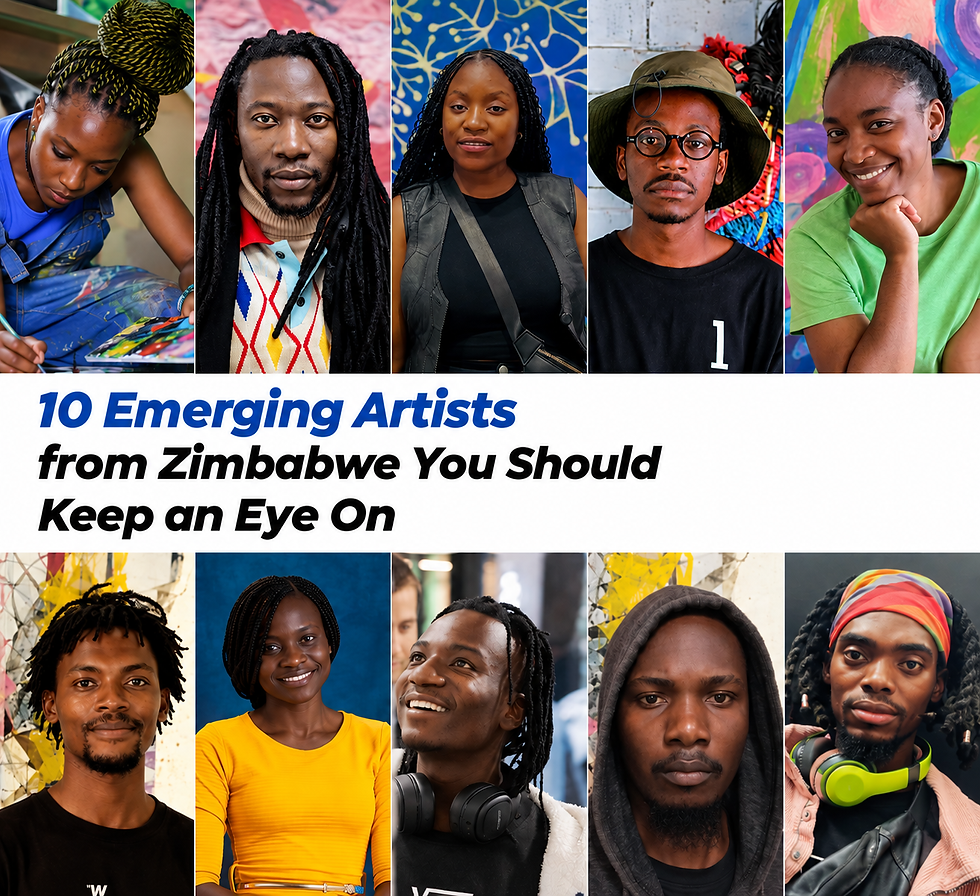
Zimbabwe’s contemporary art scene is not waiting to be discovered. It is already alive, sharp, and full of artists who work with strong material intelligence. In this younger generation, figuration returns again and again, but never as simple representation. Bodies, textiles, gestures, hands, plants, patterns, and found materials become ways of speaking about memory, survival, community, womanhood, and social pressure. Here are ten Zimbabwean emerging artists worth following.
Again Isheanopa Chokuwamba
The most striking quality of Again Chokuwamba’s paintings is their sensitive poetry. He begins with intuitively built, purely painterly layers: sensual gestures, thick patches of paint, and transparent, fluid surfaces form the ground onto which the figurative details are later placed. His figures are often outlined rather than fully solid. They appear gently and uncertainly on the canvas, often seeming to sink, fade, or hover in a half-visible state. This gives his painterly language its emotional charge.
Chokuwamba’s paintings also carry art-historical echoes. The vulnerable, floating bodies recall the Pre-Raphaelites, while the watery surfaces and drifting vegetation evoke Monet’s water lilies. At the same time, his symbols are strongly rooted in personal and collective meaning. Bodies, flowers, chairs, and pumpkins open onto questions of belonging, care, responsibility, and the individual’s place within the community.
Instagram: @again_isheanopa_chokuwamba
Nothando Chiwanga
Nothando Chiwanga works with photography and performance, often returning to womanhood, the Black female body, and the gaze placed upon it. Her series looks at what it meant to be a woman in the past, and what it means now: which images, roles, and expectations still shape women’s lives, and which ones need to be questioned.
Chiwanga often uses her own face and body in her photographs, giving the works a vulnerable and personal quality. She has described herself as an archive: everything she lives, feels,s and witnesses becomes part of the work. But this archive also holds the stories of women she grew up with, lived with, and learned from. Her works move between ritual, spirituality, and everyday female experience. They can feel ritual, yet they remain close to real memories and daily life.
Instagram: @nothie_chiwanga
William Joseph Kachinjika
William Joseph Kachinjika’s work goes back to his grandmother. She raised him, and some of his earliest memories are of watching her crochet tablecloths to sell at the market. For him, these textiles were part of everyday survival. Kachinjika first learned by watching her, then slowly turned those techniques into his own artistic language. The logic of crochet, knitting, and weaving remains in his work, but it is transformed. He uses ropes, cables, discarded textiles,s and found materials, often giving new life to threads and wires thrown away by his own community.
One of his strongest motifs is the hole. When he uses fluorescent tubes, the work begins to glow from within. This way, the hole becomes a symbol of hope, wholeness, and holding on, even in difficult conditions. His works connect inherited handicraft with contemporary Zimbabwean realities: material scarcity, power cuts, and communal survival.
Instagram: @kachinjikawilliam
Grace Nyahangare
In Grace Nyahangare’s paintings, the female body bends, stretches, twists, and adapts, as if carrying the pressure of life and personal insecurities. Her flowing bodies speak about what it means to move through the world as a woman, constantly reshaping one’s own boundaries.
Nyahangare speaks about womanhood with striking honesty: the anxieties, insecurities, and vulnerabilities many women carry, as well as the resilience, resistance, and strength that make it possible to stand up again. Her faces are strong, often mask-like. In their directness, they can recall Frida Kahlo’s deeply personal visual world, while the distorted faces and fragmented forms also enter into dialogue with Picasso’s figures.
Her technique is just as important. Nyahangare works between monotype and painting, giving the surfaces a particular vibration. Her works matter because they show womanhood as changing, fragile, adaptive, yet powerful.
Instagram: @graynyahangare
Tashinga Majiri
For Tashinga Majiri, the hand is an important metaphor: for labor and for struggle. Hands build, protect, and hold, but they can also hurt, fight, and destroy. This double nature gives the motif its strength in his paintings. In Majiri’s work, hands become characters in their own right. He does not need to show a full body for us to sense a person: a gesture is enough. His paintings also move between figuration and abstraction. The background often comes last, almost carving the forms out of the image. This reversed approach to building the painting creates a strong sense of tension: the hands and bodies seem to appear and disappear at once.
Majiri grew up in Mufakose, a township originally built for the colonial working class, so labor, survival, and the meaning of hands are not abstract ideas for him.
Instagram: @tashingamajiri
Kenmore Maruta
Kenmore Maruta’s paintings are dense, lush, and unsettling. Bright colors, twisting forms, plant-like motifs, and heavy patterns create a world that feels both natural and artificial. His grotesque language grows out of the pressures of Harare: survival, crowded urban life, unstable relationships, and hidden stories.
His figures often appear inside thick vegetation and patterned surfaces. They seem part of the landscape, yet also separate from it. Human and animal features merge; women sometimes become pig-like, beastly forms. Beauty is always mixed with something raw, instinctive, and disturbing.
Maruta’s paintings attract with color and texture, but the longer we look, the more uneasy they become. He does not separate nature from the city, the human from the animal, or beauty from distortion. He shows how they live inside each other.
Instagram: @ken_the_ghetto_flower
Amanda Shingirai Mushate
Amanda Shingirai Mushate’s paintings have a strong musical quality. Networks of swirling lines cross the surface like rhythms or sound waves meeting, forming a fragile harmony. Her paintings often feel like maps: fluid lines, vivid color fields, and layered surfaces open up inner worlds, or emotional landscapes, where memories, relationships, and lost connections flow into one another.
Movement in her work is never only formal. The lines and motifs also carry a distinctly female experience, while the images keep a sense of playfulness and joy. It is closer to the belief that change, uncertainty, and transformation can also become liberating.
Her process follows the same logic of discovery. She often begins with a thicker ground, then works with glue, paper, paint, and washes, almost like an archaeological process: bringing hidden traces out of the surface. Her sculptures have a different pace. Made from felt, their open, swirling forms are organic and creature-like, somewhere between bodies, puppets, organs, and imagined beings.
Instagram: @amandashingirai
Evans Mutenga
There is something wild and unsettling in Evans Tinashe Mutenga’s work. His images do not aim for beauty in a conventional sense. They are distorted, fragmented, and grotesque. The figures often appear in broken parts, and this fragmentation becomes a way of speaking about the human condition.
When Mutenga works on paper, the process is physical. He tears, scrapes back, and layers the surface. The scratches, ruptures, and patterns hide or show the traces of an earlier state. Out of these damaged and rebuilt surfaces, figurative details begin to emerge. Patterns play a crucial role. They decorate, but they also disturb. They thicken the image, hide the figures, then bring them back again. His works constantly move between recognition and confusion.
Mutenga’s grotesque world is not a distortion for its own sake. Behind the rawness, fragmentation, and restless surfaces are deeply human experiences: vulnerability, fear, confinement, and survival.
Instagram: @evansmutenga
Tawanda Reza
Tawanda Reza sees himself as a commentator. His work is political, but he does not paint slogans. Instead, he observes his surroundings: everyday conflicts, social fractures, and tensions that often remain unnoticed. His works show how the outside world acts on people and how social experience becomes inscribed in the body.
Discarded textiles are central to his practice because they carry both intimacy and history. Reza treats it almost as an extension of painting. Stitching, layering, folds, and tears become as important as painted gestures, giving the works a strong bodily presence.
His half-recognizable bodies and faces can be read as individuals, as social roles, as states of mind, or as collective experience. Reza’s work is raw and sensitive, showing society through its cracks, pressures, and contradictions.
Instagram: @tawanda_reza
Kimberly Tatenda Gakanje
Kimberly Tatenda Gakanje’s textile works feel like worlds the viewer can enter. They function as emotional landscapes, where color, rhythm, gesture, and pattern reflect inner states and affect us physically and emotionally. We are not given clear stories, but surfaces that make us feel. Batik or tie-dye is central to her practice. The way dye spreads, seeps, meets other colors, and loses its edges mirrors how emotions work: they are rarely clean or contained. They flow, return, overlap, and leave traces. Her works often bring together large, forceful gestures and smaller repeated patterns. This contrast gives them their rhythm. The bigger marks feel like emotional outbursts, while the smaller motifs suggest attention, repetition, and inner work. Questions of self-knowledge and healing are present, but Gakanje does not tell us what to feel. She creates space for viewers to meet the work through their own emotional memory.
Instagram: @kimberlytatendagakanje
Follow the artists on their Instagram pages to view their impressive works.
Katica is a curator and art theorist based in Budapest, Hungary


Comments