Zimbabwe’s Art Power Couples: partnerships that have helped shape Zimbabwe's art history.
by artweb

Art history often celebrates the achievements of individuals. We remember the painters whose canvases challenged conventions, the sculptors who transformed materials into powerful expressions of identity, and the curators and gallerists who brought new artistic voices into public consciousness. Yet behind some of Zimbabwe's most important artistic developments lies another story, that of couples whose shared commitment to art has shaped not only their personal lives but also the country's cultural landscape. These partnerships are significant because they extend beyond the conventional understanding of romance and companionship. They represent collaborations in which artistic practice, intellectual exchange, institutional development and a shared belief in the transformative power of culture intersect.
In Zimbabwe, where artists have often worked against considerable economic, political and institutional challenges, such partnerships have helped sustain creative communities, establish independent spaces and connect local artistic production to international audiences. From the founding of Gallery Delta in 1975 to the emergence of contemporary platforms such as Village Unhu and First Floor Gallery Harare, the influence of these creative relationships can be traced across generations.
Helen Lieros and Derek Huggins: The Pioneers Who Built Gallery Delta
The story of Zimbabwe's art power couples must begin with the late Helen Lieros and Derek Huggins, whose extraordinary contribution to the visual arts established one of the most influential institutions in the country's cultural history. In April 1975, during the final years of colonial Rhodesia, Lieros and Huggins founded Gallery Delta in three modest rooms in a building on Manica Road, Salisbury, now Harare.
At a time when Zimbabwe's art landscape was largely identified internationally with stone sculpture, particularly the movement commonly described as Shona sculpture, Gallery Delta offered an alternative platform for painting, drawing, printmaking, ceramics and experimental artistic practices. The gallery was more than an exhibition venue. It became an intellectual meeting place, a training ground and a community where artists could develop their practices beyond the expectations of established institutions and commercial markets.
Lieros, an accomplished painter of Greek heritage, brought to the partnership a profound understanding of artistic practice, technique and visual expression. Her work, often spiritual, symbolic and emotionally charged, reflected a deep engagement with questions of humanity, faith and cultural identity. Huggins complemented this artistic vision through his work as a writer, administrator, cultural advocate and gallery director. His commitment to documenting, exhibiting and promoting Zimbabwean artists helped establish Gallery Delta as an enduring independent institution.
Together, they nurtured generations of artists, including Luis Meque, Richard Witikani, Lovemore Kambudzi, Virginia Chihota, Richard Mudariki, Admire Kamudzengerere and Misheck Masamvu, among many others who passed through the gallery's workshops and exhibitions. What distinguished their partnership was its remarkable continuity. For nearly five decades, they maintained an unwavering commitment to artistic development, often placing the needs of artists and the institution above commercial considerations. Their relationship demonstrated that a gallery could be much more than a marketplace. It could function as a school, a cultural archive, a social space and a place of intellectual freedom. Both Lieros and Huggins died in 2021, within days of one another, bringing an extraordinary shared chapter in Zimbabwean art history to a close.
Their legacy remains foundational: a model of artistic partnership in which love, intellectual commitment and cultural responsibility became inseparable.
Georgina Maxim and Misheck Masamvu: Building a Village for Contemporary Art.
If Gallery Delta helped establish the foundations of Zimbabwe's modern artistic community, Georgina Maxim and Misheck Masamvu have played an important role in extending that tradition into the contemporary era. Both are internationally recognised artists with distinctive practices, yet their shared contribution to Zimbabwean art reaches beyond their individual careers.

In 2009, they founded Village Unhu, an independent artist-led initiative in Harare that has become an important platform for artistic experimentation, professional development and community engagement. The name Unhu, derived from the Shona concept of humanity, interconnectedness and collective responsibility, captures the philosophy behind their initiative. Rather than building a conventional commercial gallery, Maxim and Masamvu envisioned an environment where artists could work, exchange ideas, experiment and develop meaningful relationships with their communities. Village Unhu has provided studios, workshops, residencies, exhibitions and opportunities for emerging artists to engage with established practitioners.
Maxim's own artistic practice is deeply connected to memory, domestic histories and the emotional significance of clothing and textiles. Through stitching, layering and assembling discarded garments, she transforms everyday materials into complex visual narratives that explore absence, identity and the passage of time. Her work has gained international recognition, including participation in the Zimbabwe Pavilion at the Venice Biennale.
Masamvu, meanwhile, is among Zimbabwe's most internationally prominent contemporary painters. His energetic compositions move between abstraction and figuration, addressing the psychological, political and social conditions of contemporary existence. His paintings have been exhibited internationally, including through Goodman Gallery, and his practice continues to explore the relationship between individual experience and broader historical forces.
What makes their partnership particularly compelling is the relationship between their individual artistic languages and their collective institutional vision. Village Unhu reflects a shared philosophy. It is an environment in which artistic success is not measured solely by international exhibitions or commercial recognition, but also by the opportunities created for others.
There is also an important generational connection. Masamvu developed his early artistic practice within the orbit of Gallery Delta, attending workshops associated with the institution founded by Lieros and Huggins. In this sense, Village Unhu can be understood as part of a wider history of artistic mentorship and institution-building in Zimbabwe.
The legacy of one creative partnership finds new expression in another.
Valerie Kabov and Marcus Gora: The Partnership Behind First Floor Gallery Harare
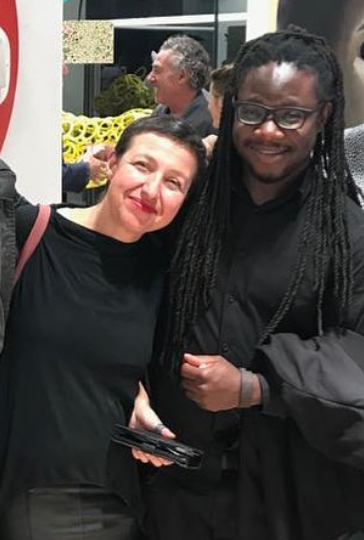
While Lieros and Huggins established a pioneering model for independent artistic institutions, and Maxim and Masamvu developed a community-centred approach through Village Unhu, Valerie Kabov and Marcus Gora have helped transform the professional and commercial possibilities available to Zimbabwean contemporary artists. Together, they founded First Floor Gallery Harare, an initiative that has developed into one of Zimbabwe's most internationally connected contemporary art galleries. Their collaboration brings together complementary professional backgrounds.
Kabov, an art historian, curator, writer and cultural advocate, has worked extensively on questions surrounding contemporary African art, cultural policy, artist development and the economic sustainability of artistic practice. Gora brings experience in music management, creative entrepreneurship, cultural production and institutional development. Before establishing First Floor Gallery, he was involved in the independent music industry.
The origins of their collaboration were remarkably spontaneous. Kabov had travelled to Harare while undertaking doctoral research in art history. After meeting Gora and discovering their shared concerns about the lack of independent platforms for emerging artists, they established an exhibition space in part of a building that Gora was already using.
What began as an experimental initiative evolved into a gallery with an increasingly international outlook.
First Floor Gallery has distinguished itself through its commitment to identifying emerging talent, supporting artistic experimentation and developing professional pathways for artists.
The gallery has also contributed to changing how Zimbabwean contemporary art is positioned within the global market. Rather than treating Zimbabwean art as a regional curiosity or limiting its identity to traditional artistic categories, First Floor Gallery has presented its artists within broader international conversations about contemporary painting, conceptual practice, cultural identity and artistic innovation. This has involved developing relationships with collectors, curators, museums, international galleries and art fairs.
Kabov and Gora's partnership is particularly significant because it recognises that artistic talent alone is not enough to sustain a successful creative sector. Artists also require professional representation, institutional knowledge, market access, critical discourse and structures that allow them to build long-term careers.
Through First Floor Gallery, the pair have helped demonstrate that independent galleries operating from Zimbabwe can participate meaningfully in the international contemporary art economy. Their collaboration also highlights the importance of combining creative vision with entrepreneurial and organisational expertise.
Portia Zvavahera and Gideon Gomo: Two Artistic Voices, One Creative Life.

Among Zimbabwe's contemporary artist couples, Portia Zvavahera and Gideon Gomo represent a particularly fascinating relationship between two distinct artistic practices.
Unlike the partnerships associated primarily with founding galleries and institutions, Zvavahera and Gomo have developed independent artistic careers while sharing a life rooted in creative production.
Zvavahera has emerged as one of Zimbabwe's most internationally celebrated contemporary painters.Born in 1985, she studied at the BAT Visual Arts Studio at the National Gallery of Zimbabwe before completing her fine arts diploma at Harare Polytechnic in 2006. Her paintings occupy a remarkable space between dreams, spirituality, memory and lived experience. Working through expressive painting and printmaking techniques, Zvavahera creates densely layered compositions populated by figures that appear suspended between physical and spiritual worlds. Her practice draws upon personal dreams, religious imagery, motherhood, relationships and the emotional complexities of human existence. Her international career has included participation in the Venice Biennale in 2013 and 2022, exhibitions at Fondation Louis Vuitton in Paris, Kettle's Yard in Cambridge, and the Institute of Contemporary Art in Boston, as well as representation by David Zwirner.
Gomo, meanwhile, has developed a sculptural practice rooted in Zimbabwe's longstanding tradition of working with stone, while incorporating wood, metal, found materials and assemblage. Born in Harare in 1983, he trained at the National Gallery's visual arts school and has exhibited internationally. His sculptures explore the psychological and emotional dimensions of human experience, often investigating vulnerability, spirituality, conflict and the pressures imposed by society.
Gomo's work is particularly concerned with emotions that men are frequently discouraged from expressing. Through sculptural forms and unexpected combinations of materials, he seeks to make visible experiences that are otherwise concealed. His selection for Zimbabwe's presentation at the 61st Venice Biennale this year marks an important milestone in his artistic career.
The couple's relationship offers an interesting dialogue between painting and sculpture, and between the visible and invisible dimensions of human existence. Although their media differ, both artists are drawn towards the psychological, emotional and spiritual experiences that shape everyday life.
In a 2015 interview with BOMB Magazine, Zvavahera discussed the practical realities of maintaining an artistic practice alongside family responsibilities, including how she and Gomo organised their working time around their children. Behind the international exhibitions, critical recognition and growing institutional interest lies the everyday reality of two artists balancing family life with the demands of professional artistic production.
What connects these four partnerships is not simply their association with art, but the different ways in which they have contributed to the development of Zimbabwe's cultural landscape. Lieros and Huggins established an enduring model of independent artistic institution-building. Maxim and Masamvu have helped create a community-driven environment in which artists can experiment, collaborate and develop their practices.
Kabov and Gora have demonstrated the importance of professional structures, international networks and market development in supporting contemporary artistic careers. Zvavahera and Gomo illustrate how two artists can maintain distinctive creative identities while sharing the personal and professional realities of an artistic life.
Together, their stories reveal the interconnected nature of Zimbabwe's art history.


Comments